

Hardware Is a Load Path, Not a Decoration
On most bag specification sheets, hardware is the last section and the least detailed. It receives a name, sometimes a colour, and rarely a load figure. Yet hardware is where a bag is most likely to be judged, and where the failure is most visible when it happens — a buckle that snaps, a hook that opens under load, a plated ring that has turned green in a customer's hand.
Every piece of hardware sits somewhere on the bag's load path. Specifying it means asking three questions: what load does it carry, what material can carry that load in this size, and what surface will survive the climate it is shipped to. Zhaoqing Yisen Bags Co., Ltd. has manufactured bags in Zhaoqing, Guangdong since 1998 with a standard hardware programme covering printing, embroidery, woven label, rubber label and metal logo finishing alongside functional hardware.
Buckle Materials: POM, Nylon and Metal
| Material | Strength | Weight | Temperament | Where it belongs |
|---|---|---|---|---|
| POM (acetal) | High for its weight; holds under repeated flex | Light | Stiff click, precise fit, resistant to moisture and most chemicals | Backpack and shoulder straps, travel bag compression, the default choice |
| Nylon | Lower than POM; more tolerant of impact | Light | Softer click, more flexible arms, less brittle in cold | Light-duty bags, cosmetic bags, applications where cold brittleness is a risk |
| Metal (zinc alloy, steel) | Highest | Heaviest | Premium feel; requires plating; can corrode if plating fails | Premium handbags, luggage, fashion bags where appearance is the priority |
Two practical notes. First, a POM buckle and a nylon buckle look nearly identical and cost similarly — the material is confirmed by the moulded identifier on the part and by a flex test, not by appearance. Second, the failure mode of an oversized metal buckle is not usually the buckle itself but the fabric it is sewn to: the hardware outlasts the panel and tears through it. Match the hardware to the fabric, not to the maximum load it can theoretically carry.
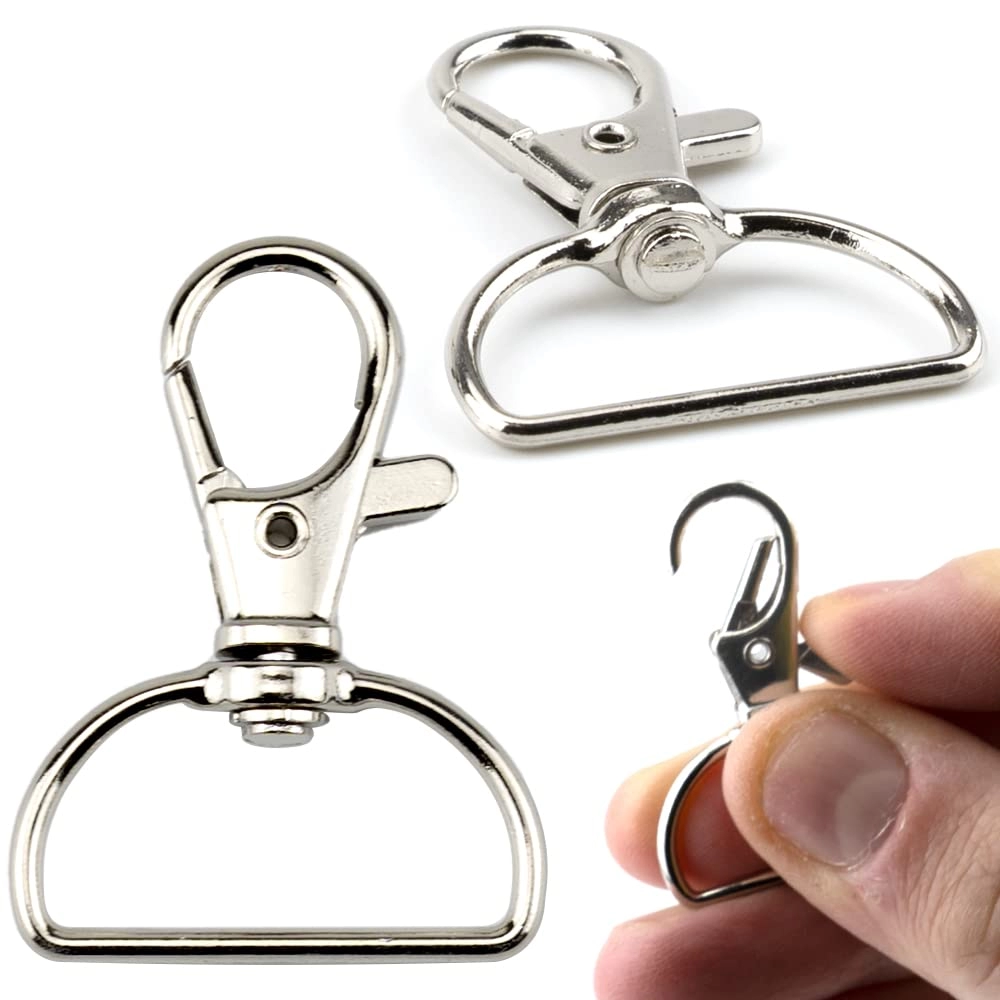
D-Rings, O-Rings and Swivel Hooks: Wire Gauge and Load
Rings and hooks are specified by wire gauge, ring diameter and finish. The gauge, not the diameter, carries the load.
| Component | Typical gauge | Indicative load | Notes |
|---|---|---|---|
| Light D-ring (cosmetic bag, pencil case) | 2.5–3.0 mm | Light | Decorative and light restraint only |
| Standard D-ring (handbag, crossbody) | 3.5–4.0 mm | Medium | Match gauge to the shoulder strap load |
| Heavy D-ring (backpack, travel bag) | 5.0 mm and above | Heavy | Often welded or formed from a single wire; check the joint |
| Swivel snap hook | Matched to ring gauge | Matched to ring | The swivel is the wear point; specify a spring that holds under load, not one that opens easily |
| Spring gate hook / carabiner | Varies | Depends on gate design | Gate strength, not body strength, is usually the limiting factor |
On any ring or hook formed from wire, inspect the joint. A ring that has been bent closed but not welded will open under sustained load, and the failure is sudden rather than progressive. For any bag intended to carry more than a light load, specify a welded or integrally formed ring.
Zipper Selection: Type, Size and Slider
Zippers are specified by type and by size number. The number describes the width of the closed teeth in millimetres, and it is the primary indicator of strength.
| Type | Character | Strength | Where it belongs |
|---|---|---|---|
| Coil (nylon) | Flexible, forgiving of curves, quiet | Moderate | Cosmetic bags, pencil cases, soft panels, curved openings |
| Vislon (moulded resin) | Rigid teeth, smooth action, strong colour hold | High | Backpack main openings, travel bags — the default for volume openings |
| Metal | Premium appearance, heaviest | High | Fashion handbags, denim-style bags; check for plating wear at the slider |
| Water-resistant / coated | Coated tape and treated teeth | Matches base type | Outdoor and utility bags; pair with a storm flap, not as a substitute for one |
| Size | Indicative use |
|---|---|
| #3 | Pencil cases, inner pockets, cosmetic pouches |
| #5 | Handbags, crossbody bags, computer bag front pockets — the most common size |
| #8 | Backpack main compartments, school bags, medium travel bags |
| #10 | Large travel bags and luggage main openings |
Two details decide whether a correctly sized zipper performs. The slider should be specified separately — locking sliders prevent drifting on travel bags but are a nuisance on frequent-access pouches, and slider finish must match the hardware or the mismatch is immediately visible. The tape should be matched to the fabric: a stiff tape on a soft panel ripples, and a soft tape on a structured panel will not lie flat.
Plating and Corrosion: What Salt Spray Actually Tests
Metal hardware is protected by plating — commonly nickel, chrome, antique brass, antique copper or a lacquer over a base metal. Plating performance is tested by salt spray, in which parts are exposed to a saline mist and inspected at intervals for corrosion and discolouration.
Two things are worth knowing about salt spray results. First, the exposure duration in hours is the meaningful figure; a claim of "salt spray tested" without a duration says nothing. Second, salt spray is an accelerated test and correlates imperfectly with real service. A part that passes a short test and then spends six weeks in a humid container, followed by a year in a coastal market, can still corrode — which is why transit conditions and destination climate belong in the hardware specification, not just in the logistics plan.
For bags shipped to humid or coastal markets, specify the plating with the destination in mind, ask for the salt spray duration, and request that the interior of the hardware — the spring, the rivet shank, the unseen side of a ring — be plated to the same standard as the visible face. Corrosion almost always begins where the plating is thinnest, and that is not the surface the customer sees on the shelf.
Magnetic Snaps and Other Closures
Magnetic snaps are specified by holding force and by the strength of the magnet, and both matter differently. A snap that holds too weakly lets a flap open; one that holds too strongly makes a bag difficult to open with one hand and can interfere with magnetic-stripe cards stored nearby. For bags intended to hold cards or electronics, specify a shielded or low-field snap, and confirm the position relative to any internal pocket.
Hook-and-loop is specified by cycle life and peel strength, and degrades with lint accumulation — a real consideration for bags used in dusty environments. Turn-locks and press studs are specified by the material of the stud and the plating, exactly as with any other metal part.
Hardware Approval Checklist
- Material confirmed by the part, not by the drawing. Check the moulded identifier on plastic hardware and the weight and finish of metal hardware on the physical sample.
- Load matched to the load path. Confirm that no hardware is stronger than the fabric it is attached to; the weakest link should be the part that is cheapest to replace.
- Ring joints inspected. Welded or integrally formed for anything carrying significant load.
- Zipper size, slider and tape all specified. A zipper line with only a size number is incomplete.
- Plating duration stated and travel tested. Ask for the salt spray hours and think about the container, not just the showroom.
- Finish matched across all hardware. Rings, buckles, sliders, rivets and logo plates must share one finish; a mixed-finish bag looks like an assembly error.
Sourcing Hardware as Part of the Bag Package
Hardware is bought from specialist suppliers, but it should be specified as part of the bag rather than as a separate purchase. When material sourcing, cutting, sewing, logo processing and inspection happen under one roof, the hardware decision is made against the actual fabric, load and destination of the bag — and the approval sample shows every part in its finished position.
Send us your reference hardware or your sampling brief, and we will return a hardware specification with the load path, the material, the finish and the plating duration stated for each part, so the bag you approve is the bag you receive.